
Saying that sea glass is unique is both a cliche and an understatement. There are multiple features of sea glass that contribute to its individuality, making price calculations challenging.
I am going to take you through the different aspects of sea glass to consider, and a guide on how I price the pieces I use in my jewelry. There are, of course, many other ways to do this, so take my methods as a starting point, and add your own spin to make it work for you! If you have ideas for improvements or have other strategies for pricing that really work for you, please comment those below! This is a place to learn after all.
The main sea glass features that impact its quality and therefore its price are:
- Color
- Frostiness
- Thickness
- Pattern
- Shape
I am going to do a deep dive into each of these topics, giving advice on how to evaluate these elements and determine their value. Today, I am going to go over the way I price my pieces.
Before I officially launched my Etsy, I have to admit, that I was pricing my sea glass “willy-nilly”, just by looking at them and deciding what felt “right.” After some thought, I realized there should be a consistent pricing strategy to ensure my prices were fair. As it turns out, each of the sea glass features listed above goes into pricing sea glass, but there are also a few other considerations.
Overhead: Also known as fixed costs or operating expenses; any cost not directly associated with the manufacturing of your product.
While in your head you’re probably thinking, “I love beach combing, so why would I need to charge for it?” The answer is because those costs can add up, and if your business grows and you need to make more frequent trips to the beach, it could get pretty pricey (especially in my case since I live 60+ miles from the beach).
In the case of sea glass, these operating expenses would be the cost of gas, price of tolls, cost of parking, and beach pass costs. To calculate how much overhead to charge per piece, add up each of the costs listed above. For example, let’s say your trip cost $13 in gas, $2 in tolls, $5 to park, with no beach pass cost, your total expense was $20.
| Gas | $13 |
| Tolls | $2 |
| Parking | $5 |
| Total: | $20 |
After you collect, wash, and sort your sea glass, you determine you have 40 pieces you are planning to use in jewelry. Divide total expense by the number of pieces to get the price per piece. In this example that would be $20/40, giving $0.50 per piece of sea glass as your baseline cost per piece. Every piece of sea glass you price will be worth at least $0.50.

After overhead is calculated, you move on to the other five attributes, which are much less time-consuming to decipher.
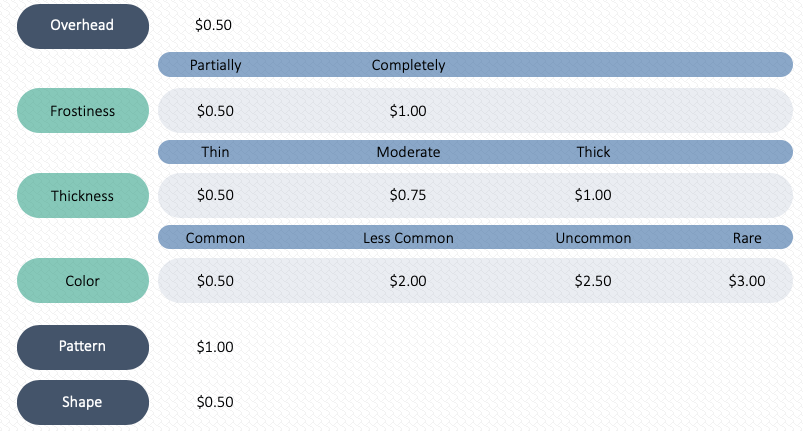
First, you have frostiness. When I evaluate this, I choose between completely frosted or not completely frosted. You could have a larger scale and various costs associated with each level, but I like to keep this attribute fairly straight-forward. If the piece is perfectly frosted, I add $1.00 to the total, if it’s not, I add $0.50.

Next, I look at the thickness, which I divide into 3 tiers: thin, moderate, thick. Depending on the size, I add anywhere from $0.50 to $1.00.

Evaluating color is the best part to me, and this element has 4 price buckets: common, uncommon, less common, and rare. I will talk more about which colors fall into which category in one of my next few posts.

Finally, the last two things to check for while pricing your sea glass are patterns and interesting shapes. If the piece has either of these, you could add on an additional amount. I keep mine fairly uniform, but I could definitely see adding more of a range depending on what patterns or shapes you may find.

Okay, so after all that, here is the completed pricing guide!!!
I will finish off this post by going through an example with you. Let’s evaluate the price of this teal piece I found on my honeymoon:

You start with the baseline overhead cost, which we calculated to be $0.50. This piece happens to be completely frosted and relatively thick, so $1.00 for each of those. The color teal is rare for sea glass, adding on $3.00, which is the last cost as there is no pattern or unique shape.
| Overhead | $0.50 |
| Frostiness | $1.00 |
| Thickness | $1.00 |
| Color | $3.00 |
| Pattern | – |
| Shape | – |
| Total: | $5.50 |
The total price for this piece would be $5.50.
Let me know how you think this pricing strategy would work for you, and I look forward to sharing more information on the various sea glass colors!
 Evrything Beachy Blog
Great insights and great blog!
LikeLiked by 1 person